Thrive Sector
Rongle R800A – Curved Non-Motorized Manual Treadmill
Rongle R800A – Curved Non-Motorized Manual Treadmill
Couldn't load pickup availability
Share


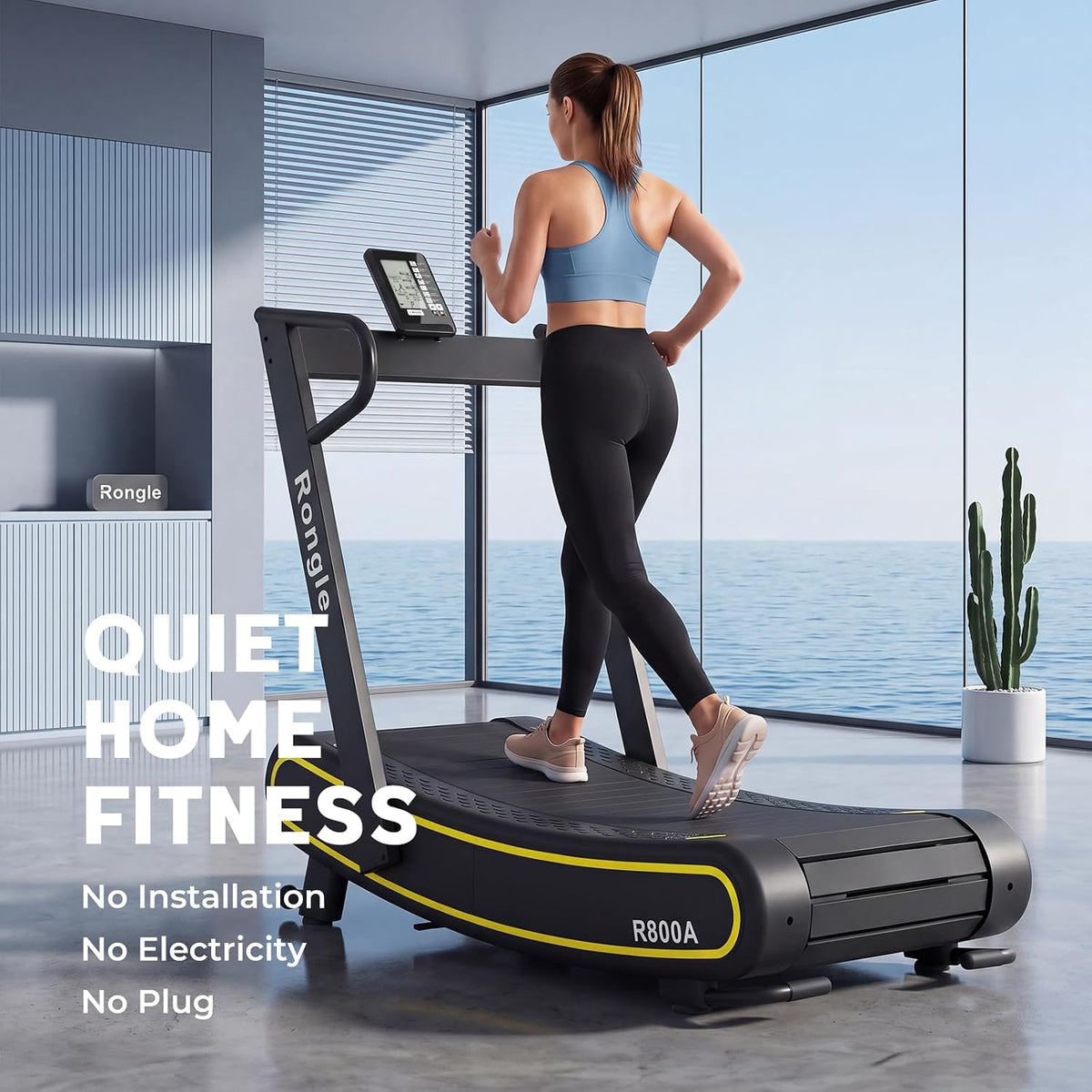
Rongle R800A – Curved Non-Motorized Manual Treadmill
The R800A is a self-powered curved treadmill. There is no motor and no power cord: the belt moves because you move it, and it stops when you stop. Speed is set entirely by where you place yourself on the curve rather than by a console, so changing pace is a matter of shifting your position — forward to accelerate, centre to hold a pace, back toward the rear to slow and stop.
That makes it a different machine from a motorized treadmill rather than a cheaper one. Because the belt only responds to your own drive, interval work needs no button presses and no waiting for a motor to spin up or down. The curved profile places the footstrike toward the forefoot, which is the characteristic curved treadmills are built around.
Eight levels of magnetic resistance are set with a lever on the upright, letting you load the belt for sled-style pushing or free it off for running.
Key Features
Self-powered, no motor and no power cord
- Entirely mechanical: the belt runs on your own drive, with no electricity required.
- No motor to burn out and no electrical components to service.
- Belt stops when you stop, with no run-on.
- Place it anywhere without needing a power outlet nearby.
Pace set by position on the curve
- Move forward on the belt to accelerate, settle centrally to hold a steady pace, drift rearward to slow and stop.
- No buttons, and no lag between deciding to change pace and the belt responding.
- Suits interval work, where a motorized treadmill's ramp-up and ramp-down time gets in the way.
Eight levels of magnetic resistance
- Resistance is set with a control lever on the upright.
- Low settings free the belt for running; high settings load it for sled-style pushing.
- Adjustable mid-session without stepping off.
Curved running surface
- Curved deck profile places the footstrike toward the forefoot rather than the heel.
- Slatted rubber belt with a raised particle texture for grip.
- Belt measures 59.06 × 15.75 inches.
Mechanical drive with sealed bearings
- Bearing-mounted slat belt runs quietly for a machine with no motor noise to mask it.
- Fewer wear components than a motorized treadmill.
- No deck lubrication schedule to keep up with.
Digital console
- Shows time, speed, distance and calories burned.
- Readable at a glance while running.
- Connects to the Zwift app for structured sessions and virtual courses.
Folding frame with transport wheels
- Folds for storage without tools.
- Arrives assembled, with no installation required.
- Transport wheels for repositioning within a room.
Specifications
| Type | Curved non-motorized manual treadmill, self-powered |
| Power | None required |
| Speed | User-determined; rated by the manufacturer to 35 km/h (approx. 21.7 mph) |
| Resistance | 8 levels, magnetic, lever-adjusted |
| Running surface | 59.06 × 15.75 in (L × W), slatted rubber belt with raised particle texture |
| Drive | Mechanical, bearing-mounted |
| Maximum user weight | 330 lb (150 kg) |
| Product dimensions | 60.63 × 27.56 × 52.76 in (L × W × H) |
| Net weight | 152 lb |
| Shipping weight | 174 lb |
| Packed dimensions | 62.60 × 29.13 × 17.72 in |
| Console | Digital display showing time, speed, distance and calories |
| App | Zwift compatible |
| Folding | Yes; transport wheels fitted |
| Assembly | Arrives assembled, no installation required |
| Brand | Rongle |
| Model | R800A |
Before You Order
- The belt is 15.75 inches wide. That is narrower than a motorized running treadmill, which typically runs 20 to 22 inches. It is workable for walking, jogging and controlled running, but if you intend to sprint at full effort, measure your own stride width against that figure first — a curved treadmill gives you no motor to fight, but it also gives you less margin for lateral drift.
- Maximum user weight is 330 lb. This is a structural limit, not a guideline.
- There is a learning curve. Self-powered curved treadmills feel unstable for the first few sessions because the belt responds to every weight shift. Hold the handrails and walk it for a session or two before running.
- It is 152 lb. Folding reduces the storage footprint, but this is not a machine one person lifts. Plan the delivery and the final position.
- Effort per mile is higher. Driving the belt yourself is harder than running on a motorized treadmill at the same indicated speed. That is the point of the machine, but it means your usual pace will feel different.
Care and Maintenance
- After each use: wipe down the handrails, console and belt surface.
- Regularly: vacuum beneath and around the frame, and check that the slats and side guards are free of grit.
- Periodically: check that frame fasteners and the resistance lever are secure, and that the belt runs true and centred.
- No deck lubrication is required, unlike a motorized treadmill.
Safety Information
This treadmill has no motor, no emergency stop button and no safety key. The belt is driven entirely by the user and stops when the user stops, so control depends on staying in contact with the belt. Hold the handrails when getting on and off, and when first learning the machine. Step on from a stationary position at the rear of the belt rather than the middle. Keep children and pets away from the treadmill at all times, including when it is not in use, as the belt can be moved by hand. Do not exceed the 330 lb maximum user weight. Use on a flat, level, hard surface with clear space behind the machine.
Speed, distance and calorie figures shown on the console are estimates intended for tracking your own activity over time. They are not medical measurements and should not be relied on for any clinical purpose. Self-powered curved treadmills demand more effort than motorized treadmills at an equivalent pace and place different loading through the calf and Achilles. If you have a heart, joint, balance or mobility condition, or you have been inactive for a long period, consult a qualified physician before starting a new exercise routine.